The Friday I Stopped Assembling Everything by Hand
Eva Yang
- use-case
- consulting
- automation
On Fridays, my calendar used to lie to me.
It showed a clean two-hour block called "client updates." In reality, that block expanded until it swallowed the afternoon.
I'm a freelance operations consultant for early-stage B2B startups. Most of my work is helping founders turn scattered activity into something the team can actually run: clearer handoffs, cleaner reporting, fewer mystery blockers.
But every Friday, I became the blocker.
To write one decent weekly update, I had to pull from project docs, GitHub issues, support exports, call notes, and whatever spreadsheet had appeared in Slack that week. One client used tidy folders. Another sent screenshots. A third renamed every file with "final_final."
The update itself was simple: what moved, what stalled, what needed a decision, and what the numbers suggested. The hard part was collecting the evidence.
By the time I finished gathering everything, I had very little energy left for the part clients actually paid me for: judgment.
The Friday I stopped assembling everything by hand
I did not come to Conol looking for a chatbot. I already had enough places to type questions into boxes.
What caught my attention was that Conol could take a job, keep working after I closed the tab, and deliver the result as an editable note instead of another chat thread.
So I gave it my most annoying recurring task:
"Every Friday at 2pm, collect updates for each active client, summarize progress and blockers, turn metrics files into simple charts where useful, draft the weekly update in my usual format, and ping me on Telegram when each note is ready."
I attached my preferred structure once: Progress, Risks, Decisions Needed, Metrics, and Next Week.
Then I closed my laptop.
At 2:41pm the next Friday, my phone buzzed. Conol had finished the first draft.
The note was not perfect, but it was usable. It had headings, links back to the source materials, a small chart generated from the latest metrics export, and a short explanation of what had changed since the previous week.
That alone saved me almost an hour.
More importantly, it gave me a starting point that was already organized.
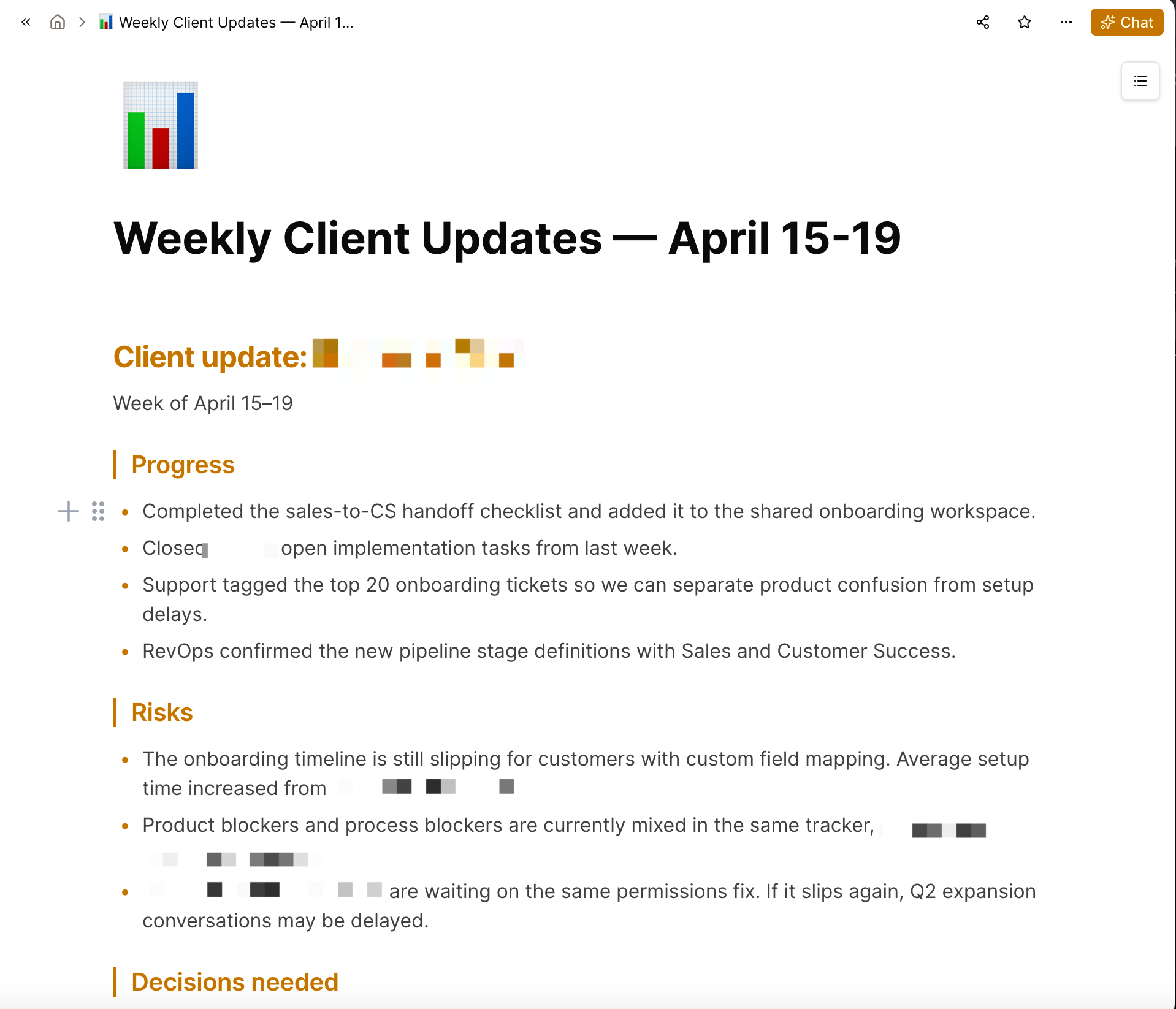
Task done easily by Conol
A different kind of workflow
The part that made Conol stick was the way the loop worked.
I did not have to reopen a browser tab to check whether it was done. I got the Telegram ping, opened the note, and reviewed it like I would review work from an assistant.
When something needed adjustment, I replied from my phone:
"Split product blockers from sales blockers."
or:
"Make the risk section more direct. This founder does not like vague language."
Conol updated the same note instead of creating a new pile of chat history.
After a couple of weeks, I added one more instruction: remember client-specific preferences. One founder wants blunt risks. Another wants every decision tied to an owner. Another only wants charts when the numbers actually changed.
Now those preferences carry forward. I do not rebuild the context every Friday.
That is the difference between "AI helped me write something" and "I delegated a recurring workflow."
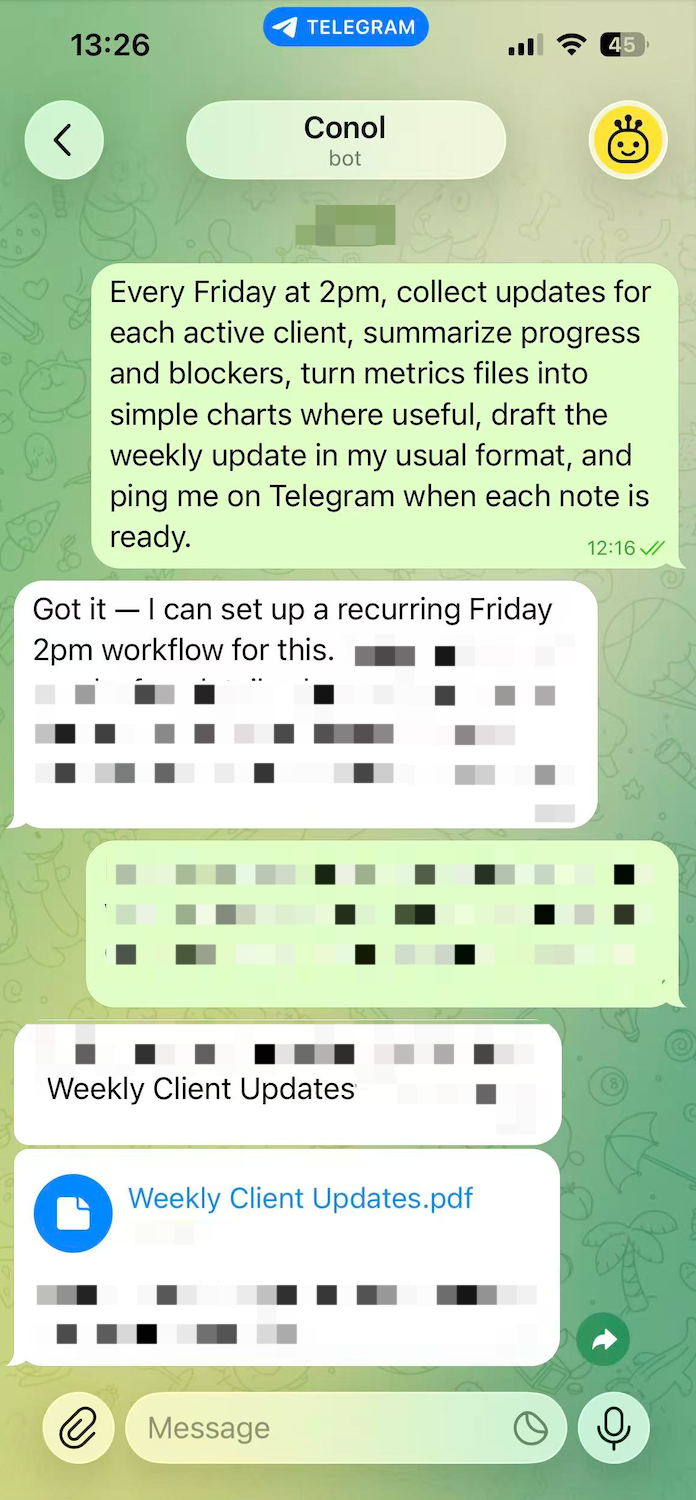
Example weekly updates from Conol
What changed in real time
Before Conol, four client updates took three to four hours. If I was unlucky, they dragged into dinner.
Now the drafts arrive before I start my final review block. I spend about 25 to 30 minutes checking the notes, tightening the recommendations, and sending the final versions.
The visible time savings are obvious. The less visible change is that I no longer start the review from a blank page or a messy folder.
Conol handles the scattered work:
- finding the latest materials
- summarizing progress across sources
- turning metrics into simple visuals
- keeping the output in structured notes
- notifying me when the work is ready
I handle the parts that require taste, context, and accountability.
For a consultant, that distinction matters. Clients do not need me to be better at copying numbers from one place to another. They need me to notice the pattern behind the numbers and say what should happen next.

The prompt I would give again
If I were setting this up from scratch, I would start smaller than I did. Pick one recurring update with a clear format and let Conol run it for two weeks.
Here is the prompt I would use:
"Every [day/time], gather updates from [sources], create a structured note using [format], include charts only when they clarify the metrics, highlight risks and decisions needed, and ping me on [Telegram/WhatsApp] when the draft is ready."
The first version does not need to be perfect. The point is to move the work out of your head and into a loop you can improve.
For me, Friday updates no longer feel like a second shift. They feel like a review meeting with an assistant who has already done the prep.
Tip
Start with one recurring update that has a clear format. Describe the sources, the structure, and where you want the ping — then let Conol run it for two weeks before expanding.
← Back to blog