From Sunday Stress to Monday Clarity: How Conol Handles Weekly Competitor Research
Eva Yang
- use-case
- small-business
- research

Running a small skincare brand means wearing a lot of hats. On any given week, I am juggling inventory, marketing, customer emails, product development, and whatever unexpected issue pops up that day.
For the longest time, though, there was one task I dreaded more than anything else: my Sunday night competitor check.
Every Sunday I would sit down with my laptop, open what felt like endless browser tabs, and spend the next hour or two checking competitor websites, comparing prices, looking for new product launches, scrolling through Instagram, and updating my spreadsheet.
It was not difficult work. It was just repetitive. And because it was repetitive, it was also the first thing I would rush through when I was tired.
The problem is that rushed research is not much better than no research at all.
A few months ago, one of our competitors quietly discounted their bestseller by around 15%. I did not notice until more than a week later, by which point our own promotional campaign was already running. We could not react in time, and I remember thinking, "There has to be a better way to handle this."
Looking for something practical, not another dashboard
A friend who runs a Shopify agency mentioned Conol. At first I assumed it would be another analytics platform I would have to learn, configure, and remember to log into.
Instead, he told me to simply describe the recurring task I wanted done.
So one evening, while I was standing in the grocery store waiting in line, I pulled out my phone and sent a message:
"Every Monday at 7am, check the pricing and new product launches from Competitor A, Competitor B, and Competitor C. Compare them with what we are running this week and send me a summary."
That was literally all I did.
I did not build a workflow or create complicated automations. I just described what I normally did every Sunday.
The following Monday, just after 7am, I received a digest on my phone while making coffee.
It included price changes from the previous week, highlighted a new discount one competitor had launched, summarized new product listings, and even pointed out where those changes might overlap with our own promotions.
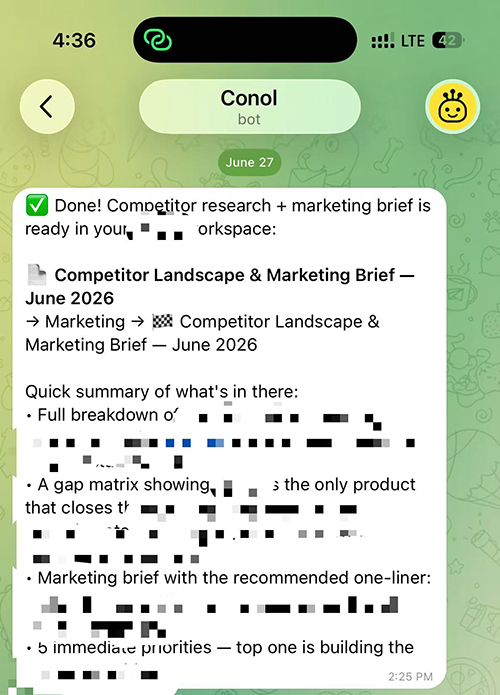
Push from Conol
After reading it, I replied with one more request:
"Also let me know if anyone restocks an out-of-stock SKU."
From then on, those updates were automatically included in every weekly report.
It felt surprisingly natural, almost like delegating the task to a teammate instead of configuring software.
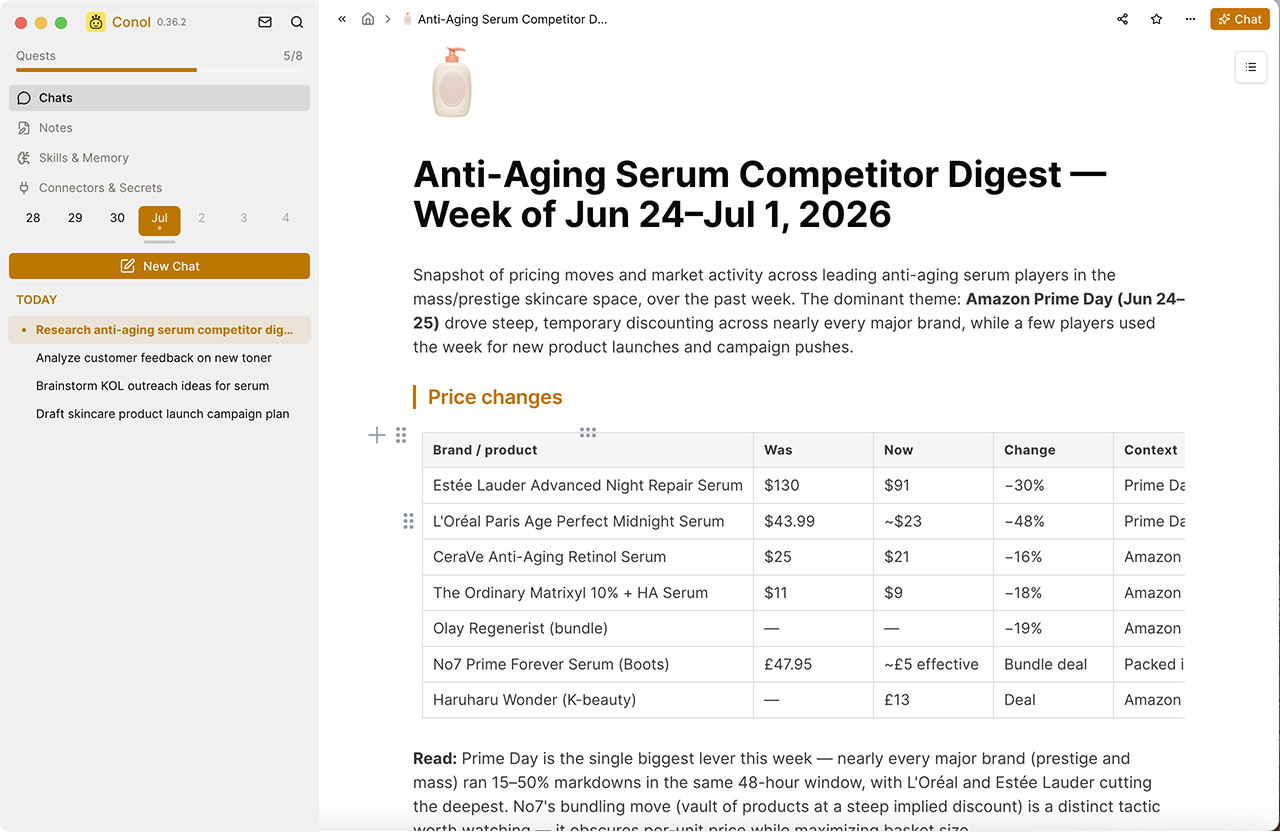
Competitor analysis report done by Conol
The biggest benefit was not the time
If I add it up, I was probably spending between 90 minutes and two hours every week on competitor research. Some weeks I skipped it entirely because other work took priority.
That is easily six to eight hours every month.
Now I spend maybe a minute or two reading the summary over coffee.
The obvious benefit is saving time, but honestly, that was not what made the biggest difference.
The real value was getting uninterrupted thinking time back.
Instead of digging through competitor websites, I started using those extra hours to call customers who had recently left reviews. I wanted to understand what almost stopped them from buying and what nearly made them abandon their cart.
Those conversations led us to rethink one of our moisturizers. We made several formulation improvements based directly on customer feedback, and it has now become one of our best-performing products.
Ironically, the insight that helped grow our business did not come from watching competitors more closely. It came from finally having enough time to talk to our own customers.
It quietly became part of my routine
What surprised me most is how quickly I stopped thinking about competitor research altogether.
Every Monday morning the update is simply there.
I read it, decide whether anything needs attention, and move on with my day.
There is no reminder in my calendar.
No spreadsheet waiting to be updated.
No mental note telling myself I should "check competitor pricing later."
It is one less recurring responsibility occupying space in my head.
That kind of mental relief is difficult to measure, but it is probably the reason I have stuck with it.

My advice if you are considering trying it
If you are evaluating Conol, I would not recommend trying to automate everything immediately.
Instead, start with one recurring task that you already know you repeat every week.
Maybe it is competitor monitoring. Maybe it is checking inventory, tracking industry news, watching customer reviews, or compiling weekly reports.
Describe exactly what you normally do, when you want it done, and where you would like the updates delivered.
Use it for a couple of weeks before deciding whether to expand into other workflows.
For me, the biggest sign that it was actually useful was not that the reports were accurate.
It was that I completely stopped thinking about the task.
The work still gets done every week. I just do not have to be the one doing it anymore.
Tip
Start with one recurring task you already repeat every week. Describe the task, the timing, and where you want the result delivered, then let Conol handle the next run.
← Back to blog